Introduction:
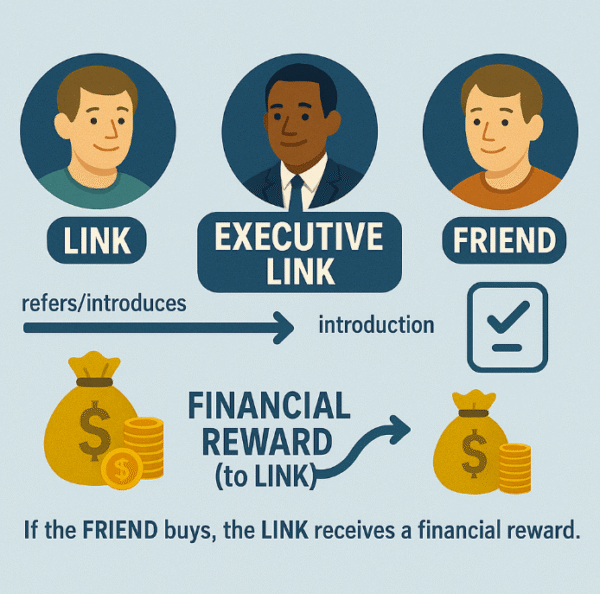
An introduction is when someone simply connects two people — typically via email, text, or in person — so they can get to know each other.
Example: “David, meet Sarah. Sarah, meet David. I think you two might have some things in common.”
The person making the introduction is neutral — they aren’t vouching for either party’s credibility or making a specific recommendation.
Referral:
A referral, on the other hand, includes a personal endorsement and recommendation. The person giving the referral is actively advocating for one party, saying, “You should do business with this person — I trust them.”
Example: “Sarah, you need to talk to David. He’s helped several of my colleagues grow their businesses using TRM — I’m confident he can help you too.”
Introduction: Based on neutral trust — the connector is facilitating a meeting but taking no stance on credibility or fit.
Referral: Based on transferred trust — the connector is lending their reputation to the referred party.
Introduction: The goal is conversation or connection — it may lead to a relationship or it may not. In fact, however, it may lead to a sale.
Referral: The goal is action — a sale, a client relationship, a partnership, etc.
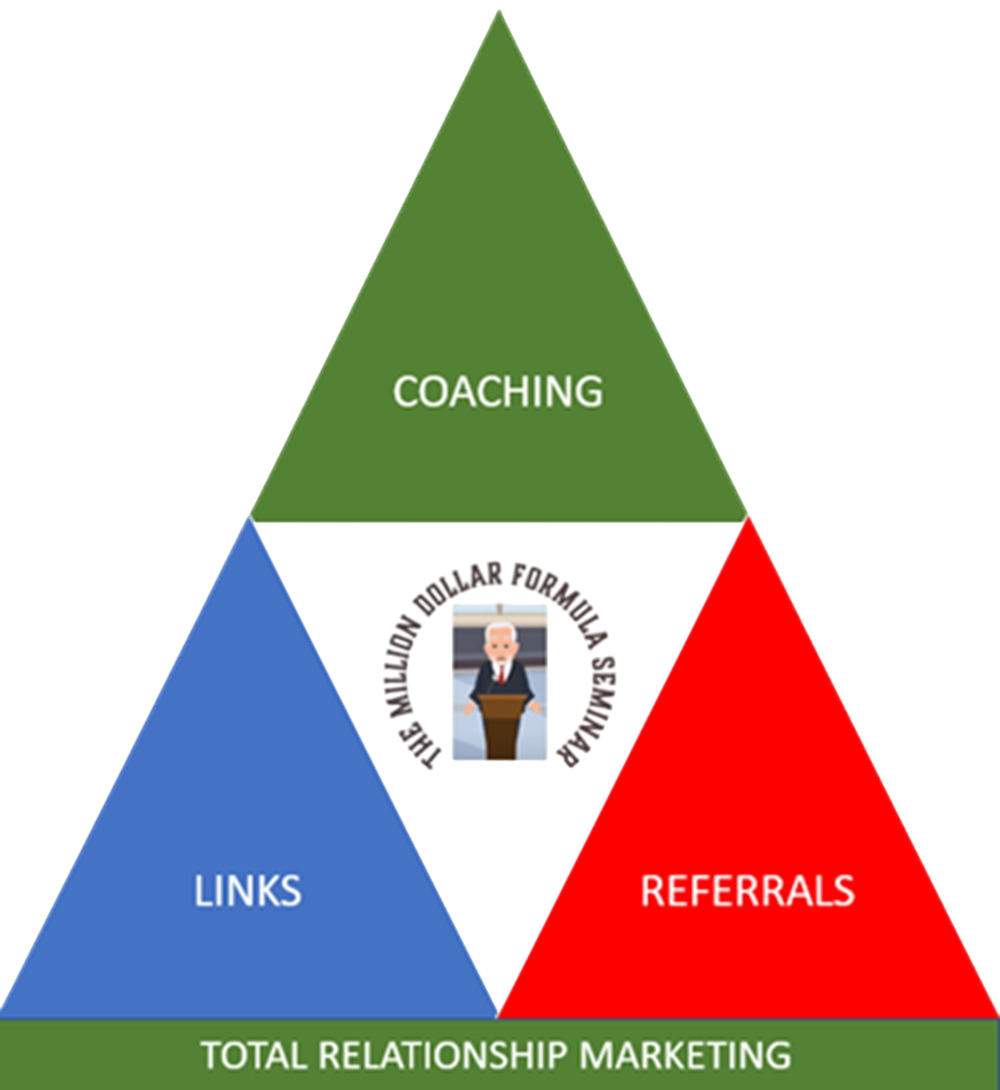
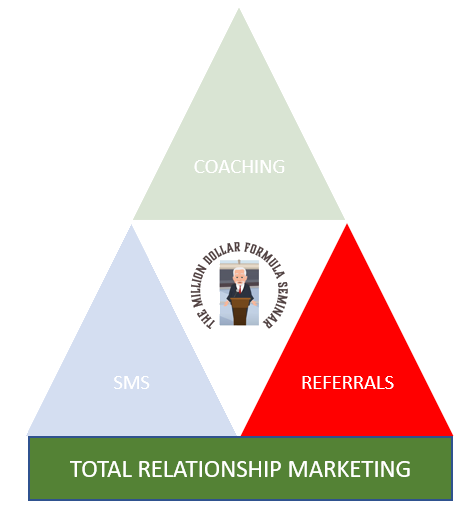
In Total Relationship Marketing, introductions build the network (LINKS), while referrals create results.
You can think of it as: Introductions build bridges. Referrals move traffic across them. Although the INTENT is different, in both cases the eventual outcome could be the same. Member Executive LINKS have the option of rewarding other members for successful referrals. A REWARD can come in the form of a reciprocal referral which is the regular understanding or in the form of a FINANCIAL REWARD when the referral is successful or both.
FINANCIAL REWARD – Getting paid for giving a referral is not “greedy”; it’s acknowledging that your influence has real value. When you receive a FINANCIAL REWARD for giving a successful referral you are receiving a THANK YOU for your efforts. It’s like an advertiser paying for advertising only when it works. The FINANCIAL REWARD is either 10% of gross revenue or a larger % of margin, is paid unless prohibited by law, and is exponentially less than any other means of advertising.
If you’re already connecting people, making introductions, and recommending good services, a referral reward simply aligns money with reality:
You’re helping someone win a new client.
You’re helping the client solve a problem.
You’re using your reputation and network as an asset.
Referrals are usually warm, simple, and fast compared to chasing cold prospects. When you receive rewards:
You can generate “bonus income” on top of your main business.
A few strong relationships can create recurring referral rewards.
It feels like “found money” because you’re not doing all the heavy lifting of fulfillment.
Knowing there’s a reward often makes you:
More attentive to opportunities in conversations.
More intentional about truly understanding others’ needs so you can match them well.
When done ethically, this increases the number of good connections you create, not just the number of random ones.
If you receive rewards from people you already believe in:
You tend to stay more engaged with their success.
You often learn more about their offers so you can refer better-fit clients.
You create long-term, “we grow together” relationships rather than one-off introductions.
NEW SALES – We know that for every three referrals received: one will be sold this year, one next year and one never which means that if an Executive LINK receives 300 promoted referred leads they will complete 100 sales. If the average commission per sale is $1,000, new revenue received will be $100,000 and FINANCIAL REWARDS of $10,000 will be paid out.
Every client or colleague can become a “mini sales rep” for you:
You only pay when results happen (performance-based).
There’s no salary, no benefits, no overhead.
The risk is low: you’re sharing profit from real revenue, not speculative leads.
Incentivizes the giving of referred leads increasing the number being received.
NEW SALES – We know that for every three referrals received: one will be sold this year, one next year and one never which means that if an Executive LINK receives 300 promoted referred leads they will complete 100 sales. If the average commission per sale is $1,000, new revenue received will be $100,000 and FINANCIAL REWARDS of $10,000 will be paid out.
This is especially powerful for small businesses or solo professionals who can’t afford a big marketing budget.
People naturally talk about businesses they like. A financial reward:
Gives them a tangible reason to talk a little more often.
Nudges them to be intentional: “Who do I know that really needs this?”
Helps your message travel into networks you’d never reach on your own.
By paying referral rewards, you’re saying:
“Your trust in me matters enough that I’m sharing profits with you.”
“I see you as a partner, not just a customer.”
This can strengthen loyalty and retention, and make people feel proud to be associated with your success.
A defined reward structure (e.g., 10% of first sale, flat $250 per closed deal, etc.) helps you:
Forecast your cost of acquisition.
Track which partners or sources are most valuable.
Refine offers or messaging that your best referrers are using.
NEW SALES – We know that for every three referrals received: one will be sold this year, one next year and one never which means that if an Executive LINK receives 300 promoted referred leads they will complete 100 sales. If the average commission per sale is $1,000, new revenue received will be $100,000 and FINANCIAL REWARDS of $10,000 will be paid out.
The referrer wants to protect their reputation, so they send you quality referrals.
You want to deliver an excellent experience, because it reflects on your referrer.
The referred client benefits from that extra care and trust in the process.
When handled openly:
The referrer feels appreciated and rewarded.
You grow your business and can serve more people.
The referred client often becomes another referrer—multiplying the effect.
SIGN INTO YOUR NOLODEX ACCOUNT
SELECT Executive LINK to INTRODUCE or REFER
PROVIDE NAME TO Executive LINK
SEND PROMOTION FROM PERSONAL EMAIL OR MESSAGE ACCOUNT
Based upon years of experience we know that promoted referrals and introductions will return extraordinary results irrespective of industry. If your objective is to increase your productivity by 100 sales, you need to receive 300 promoted referred leads each year, and if your average sale creates $1,000 of income, the result is $100,000. To get 300 referrals, GIVE 300 or more referrals. Don’t try to give 300 referrals at once. Instead, give them by over time. “INCH by INCH its a SINCH, YARD BY YARD, it’s too HARD.
If you need to create more income, give more referrals to qualified prospects. It’s as simple as that! The key is to focus your efforts within a specific market, build relationships with others who share that target market but do not compete with each other, and consistently share ideas, information, resources, introductions and referrals. THIS IS THE EFFORT WHICH IS KEY TO SUCCESS.
300
THIS YEAR
David Edstrom Coach & Consultant, Telephone: 912-484-1074, Email: David@TotalRelationshipMarketing.com,
Address:301 Harbour Place Drive, Tampa, Florida 33602